
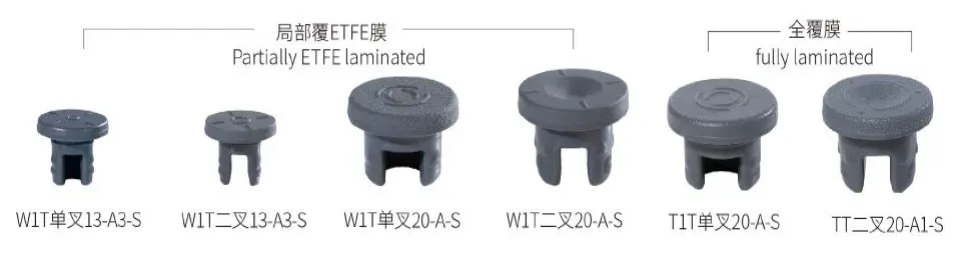
Laminated Lyo stoppers
Freeze-dry compatible pharmaceutical stoppers with halobutyl rubber + PTFE/PCTFE coating—engineered for extreme lyophilization conditions, ultra-low permeability, and global regulatory compliance for biologics and vaccines.
Our advanced lyophilization-grade rubber stoppers are purpose-built to withstand the harshest freeze-drying environments while ensuring long-term drug stability, patient safety, and manufacturing efficiency. The product excels across four pillars:
Freeze-Dry Process Resilience: The multi-layer structure—medical-grade halobutyl rubber base with PTFE/PCTFE coating—remains crack-free and dimensionally stable from –80°C to –50°C. It performs reliably under high vacuum (≤1 Pa) without outgassing, and resists stress cracking during rapid rewarming (–50°C → 25°C). With ≤2% shrinkage and ≥90% compression rebound post-lyophilization, seal integrity is preserved throughout the cycle. The design supports up to 3–5 reprocessing cycles and integrates seamlessly into automated lines (tolerance ≤0.03 mm).
Superior Sealing Protection: Ultra-low oxygen permeability (≤0.08 ml/(m²·24h·atm)) and moisture transmission (≤0.1 g/(m²·24h)) extend shelf life to 3–5 years. Perfect fit with borosilicate vials (±0.05 mm) ensures leak-proof performance, even after puncture. Nitrogen headspace compatibility and dual “stopper + cap” sealing provide robust defense against oxidation and microbial ingress during global transport.
Biological Safety & Compliance: Fully compliant with USP Class VI, ISO 10993-1, EP, FDA, NMPA, and EU MDR. Zero adsorption of proteins/peptides, extractables ≤0.08 mg/dm², and GMP production with SAL 10⁻⁶ guarantee drug purity and traceability via batch-specific CoA.
Clinical & Operational Efficiency: Available in 2–50 mL sizes, with color-coding, low puncture force (18–28 N), high tear strength (≥18 MPa), and 20% weight reduction. Custom features (e.g., alignment rings) enhance automation throughput (≥300 vials/min), reducing costs and errors in vaccine campaigns or biologic manufacturing.
| Category | Specifications / Features |
|---|---|
| Material Structure | Halobutyl rubber base + PTFE/PCTFE fluoropolymer coating |
| Low-Temperature Resistance | Stable from –80°C to –50°C; no cracking or deformation |
| Vacuum Compatibility | Performs at ≤1 Pa; no outgassing or volatile release |
| Thermal Shock Resistance | No stress cracking during rapid rewarming (–50°C → 25°C) |
| Shrinkage Rate | ≤2% during lyophilization |
| Reprocessing Cycles | Supports 3–5 freeze-dry cycles (special grades) |
| Coating Adhesion | No delamination or flaking during process |
| Compression Rebound | ≥90% after lyophilization |
| Dimensional Tolerance | ≤0.03 mm (for automated stoppering) |
| Oxygen Permeability | ≤0.08 ml/(m²·24h·atm) |
| Water Vapor Transmission | ≤0.1 g/(m²·24h) |
| Vial Compatibility | Neutral borosilicate glass; fit tolerance ≤0.05 mm |
| Inert Gas Fill Compatible | Yes (nitrogen); non-reactive coating |
| Post-Puncture Seal Integrity | Maintained for multi-dose use |
| Long-Term Seal Stability | Degradation ≤5%/year at 25°C/60% RH |
| Particulate Control | ≤1 particle per needle puncture |
| Dual-Seal System | Works with aluminum or plastic overseals for enhanced protection |
| Biocompatibility | USP Class VI, ISO 10993-1, EP 3.1 compliant |
| Extractables | ≤0.08 mg/dm² (no phthalates, heavy metals, solvents) |
| Drug Adsorption | Negligible—validated for proteins, mAbs, peptides |
| Sterilization | EO or γ-ray; Sterility Assurance Level (SAL) = 10⁻⁶ |
| Regulatory Support | CoA per batch; aligns with FDA, NMPA, EMA, EU MDR, ICH Q9 |
| Size Range | 2 mL – 50 mL |
| Puncture Force | 18–28 N |
| Tear Strength | ≥18 MPa |
| Weight Reduction | ~20% lighter vs. conventional stoppers |
| Automation Readiness | Supports high-speed lines (≥300 vials/min); optional alignment rings or anti-slip textures |
| Color Coding | Customizable (e.g., blue, purple) for drug differentiation |
| Supply Chain Durability | Damage rate ≤0.05% during transport/storage |