
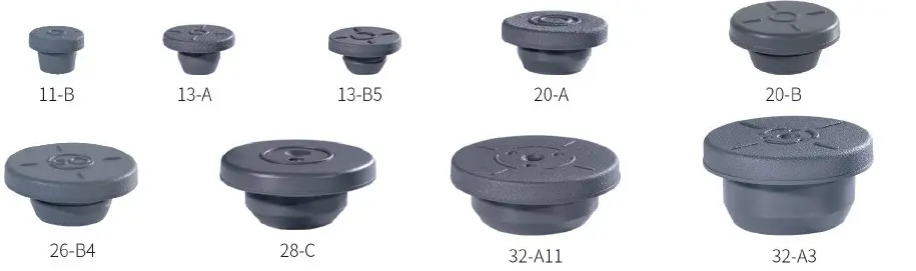
Serum Stoppers
Medical-grade halobutyl rubber stoppers with ultra-low extractables, exceptional sealing, and broad chemical compatibility—designed for sensitive injectables like vaccines, biologics, and serum products.
Engineered for the most demanding parenteral applications, our pharmaceutical rubber stoppers deliver uncompromising performance in biological safety, sealing integrity, chemical stability, and clinical practicality.
Biological Safety – Purity for Sensitive Formulations:
Made from USP Class VI, EP, and ISO 10993-1 compliant halobutyl/butyl rubber, the stoppers are non-cytotoxic, non-sensitizing, and non-irritating. Heavy metal migration is ≤0.01 mg/dm², and they contain no phthalates or residual solvents—critical for high-purity drugs like vaccines and sera. The material shows no interaction with proteins, antibodies, peptides, or enzymes (adsorption ≤0.5%), ensuring dose accuracy. With zero leachables or odor, pH remains stable post-reconstitution (ΔpH ≤0.2), preserving clarity for IV use. Sterilized via EO or γ-ray to SAL 10⁻⁶, they’re ready for direct aseptic filling. Full traceability from raw material to finished goods meets NMPA and FDA requirements.
Sealing Protection – Long-Term Barrier Performance:
High elasticity ensures compression set ≤8%, enabling leak-proof sealing even under inversion or vibration (99.9% seal pass rate). Oxygen permeability is ≤0.12 ml/(m²·24h·atm), and moisture transmission ≤0.15 g/(m²·24h), extending shelf life to 2–3 years. The smooth, non-porous surface limits microbial adhesion to ≤1 CFU/unit. Compatible with nitrogen headspace filling and stable from –20°C to 121°C, the stoppers maintain performance through cold chain logistics and autoclaving. Paired with aluminum caps, they form a dual-seal system. Long-term aging at 25°C/60% RH shows ≤3% annual seal degradation.
Chemical & Operational Stability:
Resistant to pH 2–12, metal ions, oxidizers, and sterilization cycles, the stoppers avoid swelling, precipitation, or degradation. They withstand lyophilization (–50°C, vacuum) and resist mold growth even at 80% RH. Fully compatible with common filling-line lubricants, ensuring uninterrupted production.
Clinical Efficiency:
Available in 1–50 mL sizes, with color coding (e.g., red, green), moderate puncture force (22–32 N), anti-shedding design (≤1 particle/puncture), high tear strength (≥16 MPa), and 12% weight reduction—optimizing automation (≥200 vials/min), safety, and logistics.
| Category | Specification / Feature |
|---|---|
| Base Material | Medical-grade halobutyl / butyl rubber |
| Biocompatibility Standards | USP Class VI, EP 3.1, ISO 10993-1 |
| Heavy Metal Migration | ≤0.01 mg/dm² |
| Plasticizers / Solvents | None (phthalate-free, solvent-free) |
| Protein/Peptide Adsorption | ≤0.5% |
| pH Stability (Post-Recon.) | ΔpH ≤ 0.2 |
| Sterilization Method | EO or γ-ray |
| Sterility Assurance Level | SAL = 10⁻⁶ |
| Traceability | Full batch traceability; CoA provided; NMPA/FDA compliant |
| Compression Set | ≤8% |
| Oxygen Permeability | ≤0.12 ml/(m²·24h·atm) |
| Water Vapor Transmission | ≤0.15 g/(m²·24h) |
| Microbial Adhesion | ≤1 CFU per stopper |
| Inert Gas Compatibility | Yes (nitrogen headspace) |
| Temperature Range | –20°C to 121°C (stable after thermal cycling) |
| Seal Degradation (Annual) | ≤3% at 25°C/60% RH |
| Chemical Resistance | Stable in pH 2–12; no reaction with Ca²⁺/Mg²⁺; resistant to peroxides & strong oxidizers |
| Lyophilization Compatibility | Stable at –50°C and under vacuum |
| Mold Resistance | No fungal growth at 80% RH |
| Lubricant Compatibility | No interaction with standard filling-line silicones/lubricants |
| Size Range | 1 mL, 2 mL, 5 mL, 10 mL, 20 mL, 50 mL |
| Puncture Force | 22–32 N |
| Particulate Shedding | ≤1 particle per needle puncture |
| Automation Throughput | ≥200 vials/minute |
| Color Options | Customizable (e.g., red, green) for drug differentiation |
| Tear Strength | ≥16 MPa |
| Breakage Rate (Logistics) | ≤0.05% |
| Weight Reduction | ~12% lighter vs. conventional stoppers |