
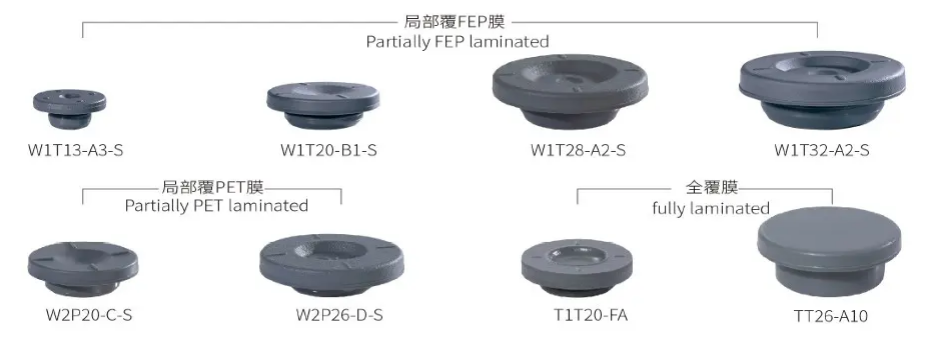
Laminated serum stoppers
High-performance pharmaceutical stoppers with multi-layer composite structure offer superior sealing, biocompatibility, and chemical resistance—ideal for vaccines, biologics, antibiotics, and other injectables requiring long-term stability and global compliance.
Engineered for the most demanding parenteral applications, our pharmaceutical rubber stoppers deliver unmatched performance across four critical dimensions: sealing integrity, biocompatibility, chemical stability, and clinical usability.
The multi-layer design—typically halobutyl rubber base coated with fluoropolymers (e.g., PTFE/PCTFE)—achieves ultra-low gas permeability (≤0.1 ml/(m²·24h·atm)), effectively blocking oxygen and moisture ingress to extend shelf life by over 30%. The smooth, non-porous surface minimizes microbial adhesion, making it ideal for sterile biologics like monoclonal antibodies and vaccines. With compression set ≤10%, the stopper maintains tight sealing even after multiple needle punctures—essential for multi-dose vials.
All materials comply with USP Class VI, EP 3.1, and ISO 10993-1, showing no cytotoxicity, sensitization, or irritation. Critically, the coating exhibits negligible extractables (<0.1 mg/dm²) and zero adsorption of sensitive APIs—including proteins, peptides, and lipophilic drugs—ensuring dose accuracy. The stoppers are compatible with both EO and γ-ray sterilization, achieving a Sterility Assurance Level (SAL) of 10⁻⁶.
Chemically, they withstand extreme pH (2–12), organic solvents, oxidizing agents, and metal-ion formulations without swelling or degradation—perfect for chemotherapy and antibiotic products. They also endure freeze-drying cycles (down to –50°C) and autoclaving (121°C/30 min) without performance loss.
Clinically, they feature optimized puncture force (20–30 N), high tear strength (≥15 MPa), and color-coding options (blue, gray, etc.) for error reduction. Lightweight (15% lighter than conventional stoppers) and automation-friendly, they reduce logistics costs and integrate seamlessly into high-speed filling lines.
Backed by full batch traceability, CoA documentation, and alignment with FDA, EU MDR, and NMPA requirements, these stoppers accelerate global market access while ensuring patient safety.
| Category | Specifications / Features |
|---|---|
| Structure | Halobutyl rubber base + fluoropolymer coating (PTFE/PCTFE) |
| Gas Permeability | ≤0.1 ml/(m²·24h·atm) |
| Shelf-Life Extension | ≥30% longer vs. standard stoppers |
| Surface Quality | Non-porous, smooth, low particle shedding (≤1 particle/puncture) |
| Compression Set | ≤10% (after repeated puncture) |
| Temperature Resistance | –80°C to +121°C (stable through freeze-thaw, lyophilization, and autoclaving) |
| Sealing Compatibility | Fits aluminum/plastic caps with ≤0.05 mm tolerance; dual-seal system |
| Inert Gas Compatibility | Compatible with nitrogen headspace filling |
| Biocompatibility | USP Class VI, ISO 10993-1, EP 3.1 compliant; non-cytotoxic, non-sensitizing |
| Extractables | ≤0.1 mg/dm² (no phthalates, heavy metals, or residual solvents) |
| Drug Adsorption | Negligible—validated for proteins, peptides, lipophilic & ion-sensitive drugs |
| Sterilization Methods | EO or γ-ray; SAL = 10⁻⁶ |
| Chemical Resistance | Stable in pH 2–12, organic solvents, oxidizers, and metal-ion solutions |
| Mechanical Properties | Tear strength ≥15 MPa; puncture force: 20–30 N |
| Size Range | Compatible with 1 mL – 50 mL vials |
| Color Options | Customizable (e.g., blue, gray) for drug differentiation |
| Traceability | Full batch traceability with Certificate of Analysis (CoA) |
| Regulatory Alignment | Supports FDA, EU MDR, China NMPA, ICH Q3D |
| Weight Reduction | ~15% lighter than conventional stoppers |
| Automation Ready | Designed for high-speed washing, filling, and capping lines |